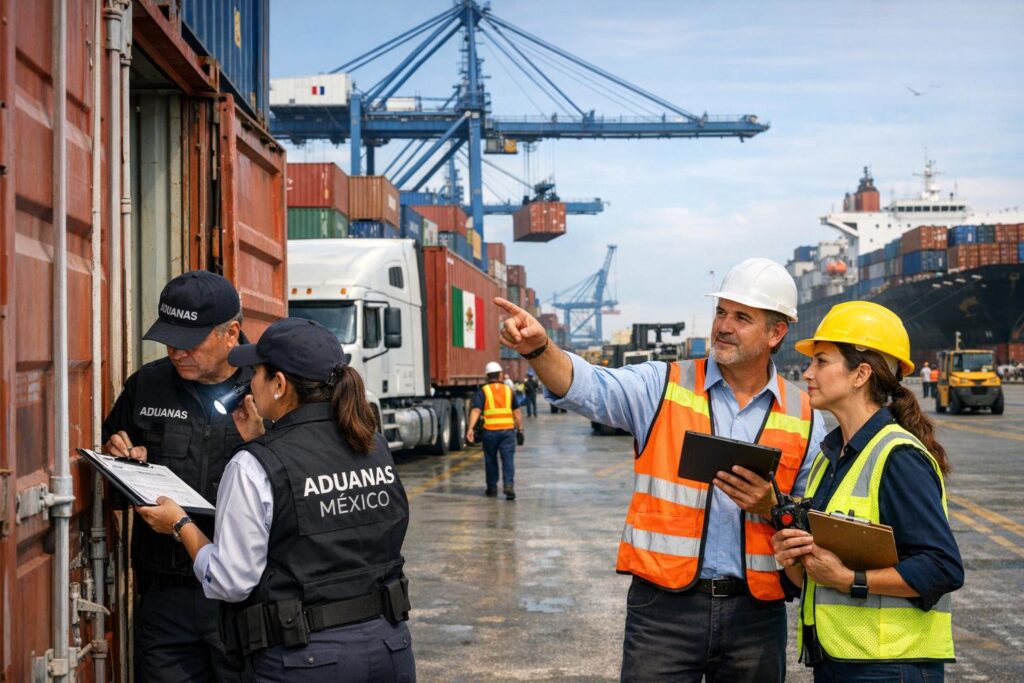
We are often asked: What is a customs broker in Mexico and why do we need one? We answer directly: A customs broker is a licensed professional who navigates complex regulations to clear goods through Mexican customs on our behalf, ensuring compliance and efficiency.
As importers and exporters across Mexico, we rely on customs brokers to save time, minimize risk, and avoid unexpected costs.
- They prepare and submit import/export documentation.
- They calculate and pay duties, taxes, and fees.
- They ensure compliance with Mexican customs regulations.
- They coordinate inspections and cargo release.
- They provide expert advice on trade agreements and tariff classifications.
- They mitigate delays and costly penalties at the border.
What Does a Customs Broker Do in Mexico?
We work closely with customs brokers who act as our official representative before the Servicio de Administración Tributaria (SAT). They handle the entire clearance process:
- Classification of goods according to the Harmonized System (HS Code).
- Calculation of ad valorem duties, value-added tax (VAT), and other applicable fees.
- Submission of the Pedimento de Importación or Exportación to SAT.
- Coordination of physical or documentary inspections by customs authorities.
- Management of special permits for restricted products.
Detailed Documentation Management
We gather commercial invoices, bills of lading, certificates of origin, and other supporting documents. The customs broker consolidates these, filling out every field accurately to avoid procedural holds.
Compliance and Risk Mitigation
We rely on our broker’s expertise to interpret Mexican regulations and avoid misclassifications. This prevents fines that can reach thousands of pesos per error.
Benefits of Hiring a Customs Broker for Mexican Importers
When we partner with a customs broker, we unlock multiple advantages:
- Efficient Customs Clearance: We reduce border delays by up to 50%.
- Cost Savings: We avoid overpayment of duties and taxes.
- Expert Guidance: We stay updated on changes in import licensing and valuation rules.
- Dedicated Support: We secure faster responses to inquiries and inspections.
- Access to Free Trade Agreements: We maximize tariff benefits under USMCA and other treaties.
Maximizing Trade Agreement Benefits
We leverage our broker’s knowledge of USMCA, CPTPP, and other agreements to certify origins correctly and apply preferential rates. This often reduces duties by up to 20–30%.
Reducing Administrative Burden
Instead of dedicating internal resources to customs tasks, we allocate our team to core business activities, increasing productivity.
How to Choose the Right Customs Broker in Mexico
We assess potential customs brokers using these criteria:
- Official License: Confirm they hold a current Federal Customs Broker license from SAT.
- Industry Experience: Evaluate track record in our specific sector.
- Geographic Coverage: Ensure they operate in the ports and borders we use most.
- Technology Integration: Check for electronic data interchange (EDI) and digital pedimento filing.
- Customer References: Request case studies and testimonials.
- Value-Added Services: Look for assistance with trade compliance audits and training.
Verifying Credentials
We ask to see the broker’s license number and verify it through SAT’s online portal. This ensures legitimacy and avoids unlicensed operators.
Evaluating Technology and Transparency
We prioritize brokers who provide client portals for real-time status updates. This transparency helps us track shipments and make data-driven decisions.
Costs and Fees Associated with Customs Brokers in Mexico
We compare fee structures to budget accurately. Common charges include:
- Brokerage fee (fixed or percentage of CIF value).
- SAT filing fee.
- Electronic Data Interchange (EDI) fee.
- Storage and handling charges if inspections delay release.
- Special permit application fees.
- Value-added services like audit support.
| Fee Type | Description | Approximate Cost |
| Brokerage Fee | Service for customs clearance | USD 50–200 or 0.1–0.5% of CIF |
| SAT Filing | Official submission fee | MXN 100–300 |
| EDI Access | Electronic document exchange | MXN 500–1,000/month |
| Special Permits | Health, security, or environmental certifications | MXN 1,000–5,000 |
Budgeting Tips
We request detailed fee breakdowns up front and negotiate volume discounts for high shipment volumes.
Customs Broker vs Freight Forwarder: Key Differences
Many of us confuse these roles, yet they serve different functions. We link to our deeper comparison for more details: Roles and Responsibilities of a Freight Forwarder vs Customs Broker.
- A customs broker acts as our legal agent before customs authorities.
- A freight forwarder manages transportation, warehousing, and logistics.
- Customs brokerage services focus on compliance and documentation.
- Freight forwarders optimize routing, carrier contracts, and cargo handling.
When We Need Each Service
If we require door-to-door delivery, we engage a freight forwarder. When we need expert clearance and compliance, we hire a customs broker.
Regulatory Requirements for Customs Brokers in Mexico
To operate legally, customs brokers in Mexico must:
- Obtain a Federal Customs Broker license from SAT.
- Undergo annual training and compliance updates.
- Maintain a surety bond for customs liabilities.
- Comply with anti-money laundering and anti-corruption regulations.
Import Licensing and Permits
We often need special permits for pharmaceuticals, chemicals, and agricultural products. Learn more in our guide: How to Navigate Mexico’s Import Licensing Requirements.
Continuous Professional Development
We ensure our broker renews their license annually and stays informed about tariff changes and regulatory reforms.
Conclusion
In our experience, partnering with a qualified customs broker in Mexico transforms complex import and export processes into streamlined, compliant operations. We trust our brokers to mitigate risks, save costs, and accelerate delivery times. Explore more resources and services at brokermx.com to optimize your international trade.
FAQ
- What qualifications does a customs broker need in Mexico?
They must hold a Federal Customs Broker license, complete SAT-mandated training, and maintain a surety bond. - How long does customs clearance take with a broker?
Clearance typically takes 24–72 hours, depending on cargo type and inspections required. - Can we file customs documents electronically?
Yes, licensed brokers use EDI systems for efficient digital filing with SAT. - What happens if there is an error in our customs declaration?
Our broker corrects the error, submits a correction, and handles any PENALTY processes to minimize fines. - Do customs brokers handle free trade zone transactions?
Yes, brokers manage documentation and compliance for goods entering and exiting Mexico’s free trade zones. - Can a customs broker help with tariff classification disputes?
Absolutely. We rely on broker expertise to research HS Codes and defend our classifications with SAT.
Ready to simplify your Mexican customs process? Contact us today to connect with certified customs brokers and streamline your international shipments.
“Working with a professional customs broker has been a game-changer for our supply chain efficiency,” says Aleyda Solís, International Trade Expert, affirming the critical role brokers play in cross-border commerce.